 QUALITY INTL CERTIFICATIONS
Rope Access Course Dubai 2026 — IRATA Fees & Path
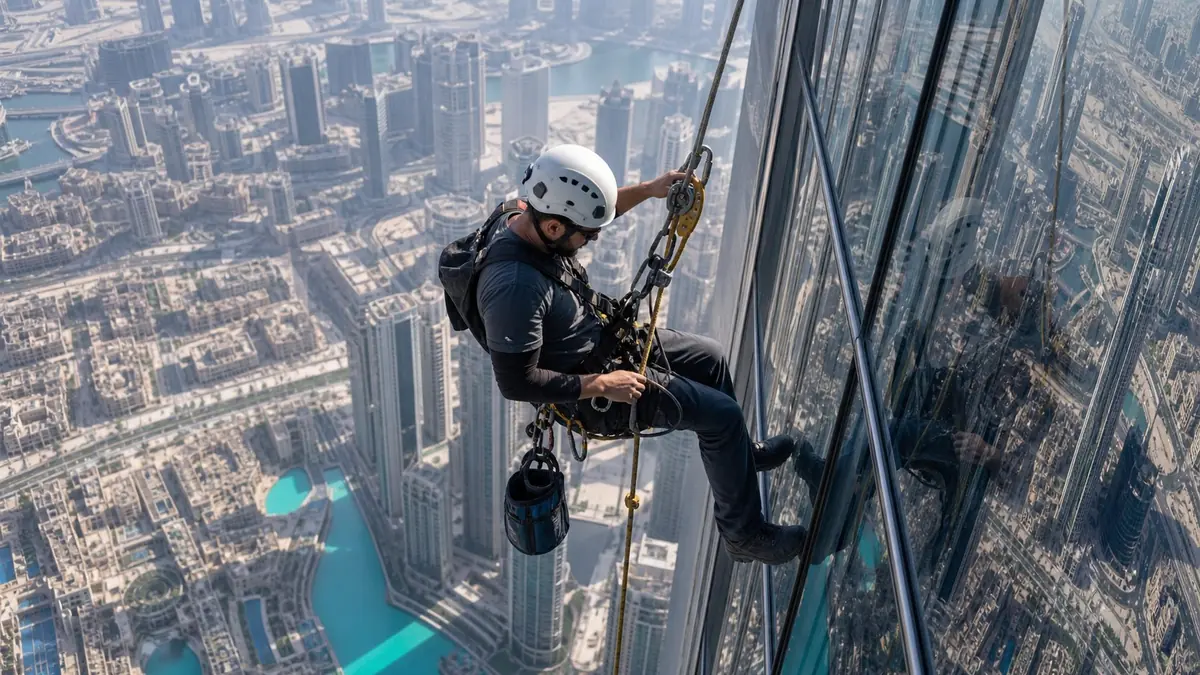
IRATA rope access training in Dubai costs indicatively AED 2,800–5,000 per level, delivered as four to five training days plus a separate independent assessment day. Level 1 qualifies rope access work under supervision, Level 2 leads rigging and rescue, Level 3 supervises sites. Your logbook — 1,000+ verified hours per level — is the only road upward.
Rope access is how Dubai's skyline actually gets touched — façades cleaned, inspections hung, repairs done where cradles can't reach. IRATA certification is the standard the UAE market prices and the one clients name. Here is what the course costs, how the levels work, and the logbook discipline that turns a trainee into a technician people phone by name. Readers weighing the two trades side by side will find the fee comparison in our forklift training Dubai fees guide — forklift versus rope access, costed honestly.
Course Fees and Structure in Dubai
Current UAE market listings put IRATA training at indicatively AED 2,800–5,000 per level, typically structured as four to five training days at the centre followed by an independent assessment day with an IRATA assessor. Fees cover training facilities and instruction; the assessment is separately structured through the scheme. Centres instructing under IRATA, OSHA and specialist equipment curricula operate across Dubai — compare on assessor access and pass-support, not just price.
The Three IRATA Levels
| Level | What You Can Do | Road to Next |
|---|---|---|
| Level 1 Technician | Rope access tasks under Level 3 supervision | 1,000+ logged hours, re-assessment |
| Level 2 Lead Technician | Rig working ropes, perform rescues, lead teams | 1,000+ further hours, re-assessment |
| Level 3 Safety Supervisor | Site supervision, rescue planning, legal duty | Experience plus ongoing assessment cycles |
What Training Actually Involves
Rope manoeuvres from day one: ascents, descents, transfers, deviations, aid-climbing, passing knots, and hauling. Then the rescue modules that the assessment grades hardest: casualty descent modes, snatch rescues and team rescue scenarios, plus rigging theory, equipment inspection and the IRATA ICOP safety framework. It is physical training — honest providers tell candidates to arrive fit, hydrate, and expect sore forearms by day three.
The Logbook Is the Career
IRATA hours log per shift, verified by a Level 3, and every upgrade assessment requires minimum logged hours at your current level. Losing or neglecting the logbook is the classic UAE career-breaker: hours you can't evidence are hours that don't exist. Photograph pages, keep them backed up, and never let originals ride in site containers longer than necessary.
Training-Centre Selection: Beyond the Price Tag
Rope access training quality splits on rig time per candidate and assessor access: centres where students spend most hours on ropes — not watching ropes — produce technicians who pass assessments and survive their first commercial jobs. Ask candidate-to-anchor ratios, how many full days run on the rig, who instructs (active Level 3s with operational logs, not classroom careers), and what happens between training and the assessment day — good centres proctor mock-assessment runs so nothing about assessment day is first-time. Price differences inside the indicative band buy these differences almost line for line.
Equipment Reality on the Job
New technicians soon learn that personal equipment — harness, helmet, descenders, cowstails, ascenders — is both safety-critical and salary-significant. Buy once, buy inspected, buy compatible with centre practice; log kit inspection like IRATA logs hours, and retire soft goods on condition, not sentiment. Employers providing kit should train their inspection discipline to the same standard — UAE sites where rope work runs keep equipment registers whose rigour resembles lifting-gear regimes, because the failure mathematics is identical.
First-Year Tactics After Level 1
The first certified year decides whether rope access becomes a career or an anecdote: chase hour-logging opportunities across sectors (facade seasons, inspection campaigns, maintenance programmes), accept the unglamorous jobs that build manoeuvre quality, and keep the logbook immaculate from day one. Technicians planning the Level 2 assessment should map how many site-weeks the 1,000-hour threshold realistically takes at their work rate and plan fees and leave accordingly. Employers building rope teams benefit symmetrically: technicians whose hours, variety and training refreshers are managed systematically deliver incident-free access work that keeps client contracts renewing.
What Technicians Earn After Certification
UAE rope access salaries track level, sector and project type — façade and maintenance work forms the base layer, while oil-and-gas and industrial shutdown rope access prices premium. Salary guides for the UAE market put technician earnings in graduated bands that step meaningfully from Level 1 to Level 3; cross-check our rope access salary guide for the 2026 bands before negotiating.
QIC (Quality International Certifications) supports rope access careers in the UAE with training-pathway guidance, third-party inspection services for the clients who hire rope teams, and verification support for employers.
Checklist
- Budget indicatively AED 2,800–5,000 per IRATA level.
- Choose centres on assessor access and pass support, not price alone.
- Arrive fit — ascents and rescues grade physical.
- Start the IRATA logbook from your first certified day.
- Back up logbook pages photographically, always.
- Plan Level upgrades around the 1,000-hour minimums.
- Inspect personal equipment before every rope day.
- Verify centre credentials before paying any deposit.
Rope Access Training Dubai — Choosing a Centre and Budgeting the Levels
The searches that arrive here are typed three ways — "rope access training Dubai", "rope access training center in Dubai" and "rope access course price" — which is really one question with two answers: which centre, and what budget. Current UAE market listings put IRATA training at indicatively AED 2,800–5,000 per level, structured as four to five training days plus an independent assessment day. Budget the level you are entering, not the whole ladder — most technicians pay as they climb, and employers increasingly sponsor Level 2 and Level 3 for proven Level 1s.
| Stage | Structure | Indicative Fee (AED) | Who Pays It |
|---|---|---|---|
| IRATA Level 1 | 4–5 training days + assessment day | 2,800–5,000 | Usually the candidate — the entry ticket |
| IRATA Level 2 | 4–5 days + assessment (needs logged hours) | 2,800–5,000 | Often employer-sponsored once productive |
| IRATA Level 3 | 4–5 days + assessment (supervisor grade) | 2,800–5,000 | Employer — supervisory ROI is immediate |
| Refresher / revalidation | 1–2 days, cycle per scheme rules | Fraction of full course | Whoever holds the logbook's future |
Choosing among Dubai's training centres comes down to three checks that price tags hide: assessor access (independent IRATA assessors, not the instructor marking his own class), pass-support policy (what happens if the assessment day goes wrong — a resit plan or a shrug), and logbook culture (a centre that drills the logging habit protects your Level 2 eligibility a year later). For the fee breakdown per scheme, see our IRATA rope access course fees guide, for what other inspection training costs in the same market the training fees schedule, and for what the qualification returns offshore, the offshore salary reality.
Frequently Asked Questions
How much does a rope access course cost in Dubai?
Indicatively AED 2,800–5,000 per IRATA level, structured as four to five training days at the centre plus an independent assessment day — with total career cost scaling across the three-level ladder.
How long is IRATA Level 1 training?
Typically four to five training days plus a dedicated assessment day with an independent IRATA assessor, with practical manoeuvre and rescue standards that must be demonstrated on the day.
What can I do with an IRATA Level 1 certificate?
Perform rope access tasks under Level 3 supervision — with upgrades to Level 2 (rigging and rescue leadership) and Level 3 (site supervision) requiring 1,000+ verified logged hours per step plus re-assessment.
What is the average salary for a rope access technician in Dubai?
Salaries step by level, sector and project type — base bands at Level 1 in façade and maintenance work, premium bands in oil-and-gas and shutdown access; our UAE rope access salary guide gives the graduated 2026 numbers.
Is IRATA the only rope access certification accepted in the UAE?
IRATA is the dominant market standard clients specify; other schemes exist internationally but UAE client specifications consistently name IRATA — pragmatism says certify where the work orders point.
How much does rope access training cost in Dubai?
Indicatively AED 2,800–5,000 per IRATA level in current UAE market listings, covering four to five training days plus an independent assessment day structured through the scheme. Level 1 is normally self-funded as the entry ticket; Level 2 and Level 3 are frequently employer-sponsored once the technician is productive. Always request a written all-in figure separating training, assessment and any resit rights before paying.
How do I choose a rope access training centre in Dubai?
Judge centres on three things the brochure will not tell you: whether assessment is conducted by an independent IRATA assessor rather than the course instructor, what the written resit policy is if the assessment day goes against you, and how seriously the centre drills logbook discipline — because logged hours are what unlock Level 2 eligibility later. Visit before paying, ask to see a class in progress, and get the all-in fee in writing.