 QUALITY INTL CERTIFICATIONS
Transom Scaffolding in the UAE: Types, Sizes and the Load They Carry
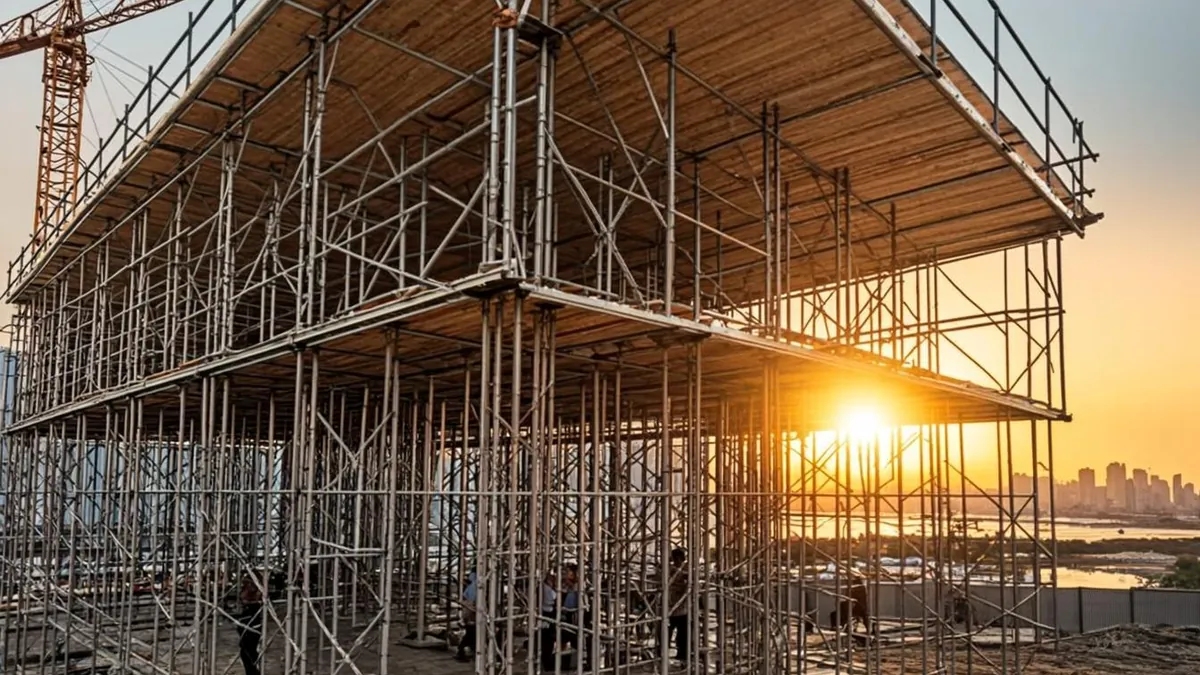
A transom is the horizontal scaffold member that sits at right angles to the ledgers and directly carries the working deck — the boards you stand on rest on transoms, not on ledgers. Standard lengths track bay widths from about 0.6 m to 3.2 m, they connect to standards through couplers or system nodes, and EN 74-1 couplers with BS EN 12811 load classes are the compliance reference UAE inspectors work to.
What a Transom Is — and What It Is Not
Every scaffold has two families of horizontal members, and mixing them up is the most common vocabulary error on site paperwork. Transoms run across the short dimension of the bay and carry the deck; ledgers run along the length and tie the standards together. When you stand on a scaffold, your weight goes board → transom → standard → base plate → ground. The ledger's job is structural continuity; the transom's job is carrying you. That single distinction explains everything else — why transoms are spaced to board strength, why their ends corrode fastest, and why inspectors read them first. The clamp that fixes each transom square to its support is the double coupler — covered in full in our double coupler scaffolding guide.
On tube-and-fitting scaffolds, a transom is just a cut tube fixed with right-angle couplers. On system scaffolds (cuplock, ringlock), transoms are purpose-made members with forged ends that drop into the node — faster to erect, impossible to mis-place, and the reason system decks behave more predictably under load.

The Transom Types You Will Meet on UAE Sites
| Type | Where It Fits | What It Adds |
|---|---|---|
| Tube transom (cut tube + couplers) | Tube-and-fitting scaffolds | Universal; position set on site by the crew |
| System / unit transom | Cuplock, ringlock and similar systems | Forged node ends — fixed geometry, fast erect |
| Board-retaining transom | Working lifts at height | Lips or flip locks that stop boards lifting or sliding |
| Intermediate transom | Wide bays, heavy deck loads | Halves the board span without extra standards |
The row that decides inspections is board retention. A plain transom supports a board; a retaining transom secures it. At working lifts — and anywhere wind, traffic or lift-out operations reach the deck — the difference between the two is the difference between a finding and a pass, because an unsecured board that walks off a transom is a dropped object with paperwork.
Standard Sizes and the Spacing Logic
Transom lengths track the bay widths crews actually build: roughly 0.6, 0.9, 1.2, 1.5, 1.8 and 2.4 m are the working set, with 3.0–3.2 m members appearing where access or structure demands wider bays. Spacing between transoms is governed by what the boards can span — timber scaffold boards are strength-rated for defined spans, and exceeding the span table turns a compliant deck into a trampoline. Where a bay must run wide, intermediate transoms halve the board span rather than hoping the boards are feeling strong today.
How Transoms Actually Carry the Load
The load path is short and unforgiving: deck load bends the transom, the transom delivers that load through its end connections into the standards, and the standards stack it down to the base plates. Two consequences follow. First, the end connections are the critical zone — coupler slip or node wear where transom meets standard undoes everything the member itself can take. Second, eccentric loading (loads hung off the board edge, or pallets dropped on one side) twists the transom in a direction it was never sized for, which is why material placement rules on working decks exist and why inspectors watch where the pallets actually land.

Compliance: What the Standards Say
The reference set UAE inspection practice works to is familiar from the rest of the scaffolding family: BS EN 74-1 governs the couplers and nodes that hold transoms in place, and BS EN 12811-1 defines the load classes a working deck must achieve. Scaffolds are designed to a load class — the class decides transom spacing, board grade and tie pattern together — which means "more transoms" is not automatically "more compliant"; the deck has to match its designed class, not exceed or undershoot it. The site's scaffold design drawing is therefore the first document a competent inspector asks for, before a single transom is measured.
What Fails When Transoms Fail — Inspection Findings
| Finding | Why It Happens | What It Demands |
|---|---|---|
| Corroded or deformed ends | Ends sit in water traps and splash zones | Reject the member — end damage is load-path damage |
| Missing board retention at working lifts | Plain transoms used where retaining specified | Swap or add retention before the lift is used |
| Over-spanned boards | Wide bays without intermediate transoms | Add intermediates to halve the span |
| Loose or worn couplers / nodes | Erection shortcuts, re-use fatigue | Re-torque or replace; re-inspect the lift |
| Bent members from overloading | Material stacked beyond design class | Quarantine the lift; engineer's assessment |
Every row in that table is visible from the deck with a torch and two minutes — which is the entire philosophy behind weekly inspections and the tag system. The full regime — frequencies, who may inspect, what the tag colours mean — is documented in our scaffolding inspection requirements guide, and the edge-protection members that complete a safe deck are covered in the toe board guide.

Erection and Dismantle Notes That Protect the Deck
- Erect transoms before boards, always — a board laid on ledgers "temporarily" is the classic dismantling-stage fall cause.
- Never release a loaded transom's couplers during dismantling; unload the deck, then strip from the far side back.
- Check board bearing at every joint — each board end needs its transom, with the overlap the board grade requires.
- Keep retention hardware with the member — a retaining transom missing its flip locks is a plain transom wearing a costume.
Dismantling statistically hurts more crews than erecting, because the scaffold is being un-built exactly as its stability logic is being removed. The sequence above is the discipline that keeps that statistic boring — and it pairs with the footing checks in our base jack guide and the component naming in the parts name list for full crew induction material.
Frequently Asked Questions
What is a transom in scaffolding?
The horizontal member set at right angles to the ledgers that directly carries the working deck — scaffold boards rest on transoms, and the load path runs board to transom to standard to ground. Ledgers tie the standards together along the scaffold's length; transoms are the members doing the carrying, which is why their spacing follows board strength and their end connections are the first thing inspectors read.
What is the difference between a transom and a ledger?
Direction and duty: ledgers run longitudinally along the standards and provide structural continuity, while transoms run across the bay and physically support the deck boards you stand on. Confusing the two on inspection paperwork matters because the failure modes differ — ledgers fail in tension at couplers, transoms fail in bending and at their corroded ends.
What are standard transom sizes?
Working lengths track bay widths — approximately 0.6, 0.9, 1.2, 1.5, 1.8 and 2.4 m are the common set, with 3.0–3.2 m members used where wider access bays are required. Spacing between transoms is set by the board span table for the deck's board grade; wide bays take intermediate transoms rather than over-spanned boards.
How often should transoms be inspected?
Transoms are inspected with the scaffold under the standard regime — after erection and before first use, at defined periodic intervals thereafter (commonly weekly on UAE sites), and after any event that could affect the structure. Inspectors read the end connections, board retention hardware and board bearing at joints first, because those three points carry most of the deck's risk.
Do transoms need board retention?
At working lifts and anywhere boards can be lifted, slid or disturbed — yes, plain transoms are not enough and retention (lips or flip locks) is required. Unsecured boards on working decks are treated as dropped-object hazards in inspection findings, and the fix is member replacement or added retention hardware, not stricter housekeeping rules.