Calibration Services in UAE: The Complete ISO/IEC 17025 Guide
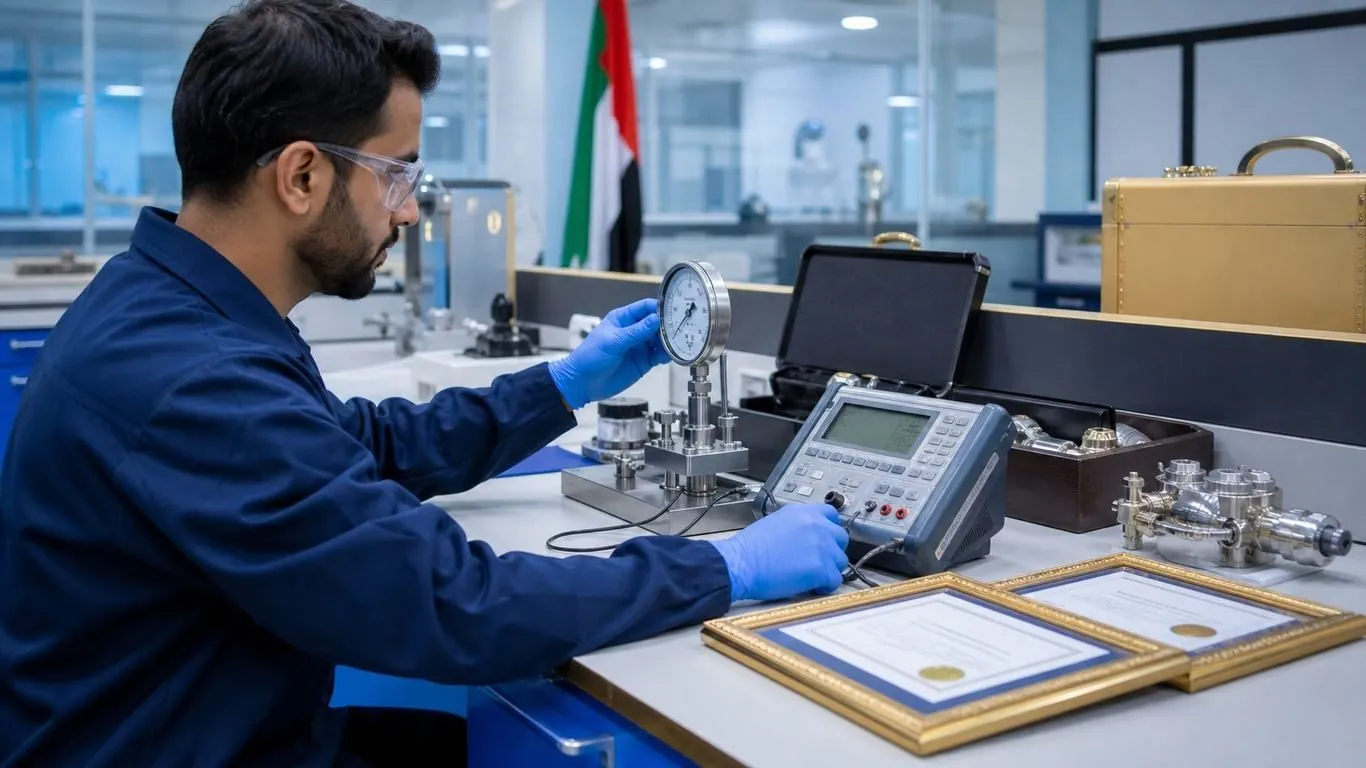
Calibration services in the UAE compare your measuring instruments against traceable reference standards and issue an ISO/IEC 17025-accredited certificate recording as-found/as-left errors and measurement uncertainty. Most instruments run on annual cycles; critical ones (pipettes, gas detectors, balances) need 3–12 month intervals. Always choose a lab accredited by ENAS or EIAC — auditors reject non-accredited certificates in ISO 9001, GMP and ADNOC vendor audits. Full scope, intervals, certificates and cost logic below.
Every product you ship, every weld you certify, every batch you release is only as good as the instruments that measured it. Yet calibration is the most quietly neglected line in most UAE maintenance budgets — until an auditor finds a batch produced with an out-of-tolerance gauge. This guide gives you the whole picture: what accredited calibration actually delivers, how to set intervals, what a valid certificate contains, and how to buy calibration services without overpaying.
1. Calibration, Verification, Adjustment — Three Words People Mix
Calibration documents how wrong (or right) your instrument is compared to a reference standard. It does not fix anything. Adjustment is the technician tweaking the instrument back within tolerance. Verification is a quick pass/fail check. In audit language: only an accredited calibration certificate proves your measurement chain is trustworthy — a green sticker from an unaccredited vendor proves nothing.
2. Why Calibration Is Non-Negotiable in the UAE
- ISO 9001 (clause 7.1.5): monitoring and measuring resources must be calibrated at specified intervals with traceability — checked in every audit.
- Oil & gas: ADNOC and operator specs require calibrated test instruments (pressure recorders, torque tools, gas detectors) with traceable certificates; CICPA-controlled zones enforce it at the gate.
- Pharma & food: GMP, GLP and HACCP programs fail without documented calibration schedules.
- Trade & safety: weighbridges, fuel meters and safety-relief devices feed billing and life-safety decisions — silent drift is silent loss.
3. ISO/IEC 17025 — The Accreditation That Makes Certificates Count
ISO/IEC 17025 is the international standard for the competence of testing and calibration laboratories. An accredited lab has proven — to ENAS (UAE) or EIAC — that its reference standards, methods, environment, staff and uncertainty budgets are sound. When you buy "17025-accredited calibration" you are buying four things no cheap alternative offers:
- Traceability — an unbroken chain from your gauge to national/international standards.
- Measurement uncertainty — the stated ± band on every result; auditors read this first.
- Competent staff & environment — controlled lab conditions (temperature, humidity, vibration) and trained metrologists.
- Globally recognized certificates — ENAS/EIAC accreditations are ILAC-recognized, so your certificate works with foreign clients and regulators.
4. What a Valid Calibration Certificate MUST Contain
Before accepting any certificate, check these nine items — missing any one means a weak or fake certificate:
- Lab name, address and accreditation scope/logo (ENAS or EIAC, with certificate number)
- Instrument identity: make, model, serial number, asset ID
- Date of calibration and environmental conditions
- Reference standards used (with their traceability)
- As-found and as-left readings at each test point, with limits
- Measurement uncertainty stated for each measurement
- Pass/fail or tolerance class statement
- Technician and authorized signatory names/signatures
- Due date / recommended next calibration
5. Instruments We Calibrate — The Full UAE Scope
| Category | Common Instruments |
|---|---|
| Pressure | Gauges, transmitters, digital indicators, test gauges, vacuum gauges, pressure calibrators, deadweight testers, relief valves, switches |
| Temperature | Glass/digital/IR thermometers, dry-block calibrators, UTI tapes, baths, controllers, recorders, hygrometers |
| Dimensional | Vernier calipers, micrometers, dial gauges, feeler gauges, bevel protractors, coating thickness gauges |
| Electrical | Multimeters, clamp meters, insulation testers, oscilloscopes, panel meters, HV test sets, function generators, decade boxes |
| Mass | Digital scales, standard weights, top-loading balances, weighbridges |
| Force & Torque | Torque wrenches, tensile load links / dynamometers |
| Volume | Micropipettes, graduated cylinders, pipettes (fixed & variable) |
| Gas Detection | Combustible/toxic/oxygen monitors, multi-gas detectors, IR analyzers, breath alcohol detectors |
| Medical & Lab | Ovens, incubators, centrifuges, autoclaves, water baths, refrigerators, pH meters, biosafety cabinets |
| Refrigeration | Chillers, freezers, blast chillers, walk-in rooms, refrigerated transport |
6. Calibration Intervals — The Realistic Master Table
Manufacturers, regulators and usage define your interval. These are the guidelines UAE auditors accept as defensible defaults:
| Instrument | Typical Interval | Notes |
|---|---|---|
| Pipettes (GMP labs) | 3–6 months | Research labs: 6–12 months |
| Balances & scales | 6–12 months | Daily check with test weights in between |
| Pressure gauges | 12 months | Critical/safety service: 6 months |
| Thermometers / temperature loggers | 6–12 months | Cold chain: before each season |
| Portable gas detectors | 6 months | Plus bump test before each use |
| Torque wrenches | 12 months or 5,000 cycles | Whichever comes first |
| Dimensionals (calipers, mics) | 12 months | Heavy shop use: 6 months |
| Electrical (multimeters, testers) | 12 months | Reference standards: 24–36 months |
| Centrifuges, ovens, incubators | 12 months | GMP: per validation protocol |
7. On-Site vs Laboratory Calibration
| On-Site | Laboratory | |
|---|---|---|
| Best for | Production lines, weighbridges, fixed gauges, gas detection grids, heavy equipment | Reference standards, precision dimensionals, small instruments |
| Downtime | Near zero — instruments stay on site | Transport time (usually 1–3 working days) |
| Environment | Field conditions (technicians adapt methods) | Controlled temp/humidity — highest accuracy |
| Cost logic | Day-rate + travel; great for 10+ instruments | Per-item; great for small batches |
8. UAE Regulators & Accreditation Geography
In the UAE, the accreditation bodies that count are ENAS (Emirates National Accreditation System — Abu Dhabi) and EIAC (Emirates International Accreditation Centre). Oil & gas sites add their own gates: ADNOC-registered vendors, and CICPA permits for restricted critical zones. When a client or auditor asks "who accredited your lab?", the answer should roll off the certificate itself — logo, scope and number.
9. Building a Calibration Management System (So Nothing Ever Lapses)
- Master instrument register — every instrument: ID, serial, location, interval, owner.
- Recall schedule — automated reminders 30 days before due dates.
- Status labels — calibration stickers with ID/date/due on every instrument.
- Use-only-when-valid rule — expired tag = instrument quarantined, no exceptions.
- Certificate archive — digital PDFs indexed by serial number, retrievable in any audit in under 5 minutes.
- Review loop — shorten intervals for instruments that repeatedly fail as-found; lengthen (carefully) for stable ones.
10. How Pricing Works (And How to Pay Less)
Calibration is priced per instrument by four factors: parameter, range, accuracy class, and location (on-site vs lab). The three levers that cut your bill:
- Batch lists: send the full register at once — per-item prices drop sharply at volume.
- Framework contracts: annual agreements fix rates and guarantee turnaround.
- Plan around shutdowns: on-site jobs during planned maintenance kill two costs with one visit.
For a same-day quote, WhatsApp a photo of your instrument list (or the register itself) — parameter + make/model + range is all we need.
11. Why Companies Across UAE Choose QIC
Calibration is one of our five accredited disciplines alongside lifting inspection, ISO certification and training. Our calibration team serves manufacturing, oil & gas, pharma, food and laboratories with ISO/IEC 17025-compliant methods, fast turnaround and certificates auditors accept the first time — on-site across all seven Emirates or through our Abu Dhabi facility. For the mechanical integrity half of the maintenance picture — rigging gear and hydraulic plant examinations — see the rigging inspection services guide.
Instruments Due for Calibration?
Send your instrument list (parameter + make/model + range — a photo works) — same-day itemized quote, on-site or lab, with certificates your auditors will accept.
💬 WhatsApp: Calibration QuoteCalibration Services in the UAE — the Prequalification Readiness View
Two of the biggest queries this page receives are "calibration services in UAE" and "prequalification readiness check UAE" — and they are the same question asked from two sides. Calibration services in the UAE are accredited laboratory and on-site activities that keep measuring instruments traceable, certified and audit-ready; a prequalification readiness check is the audit-side view of the same thing: proving to a client, regulator or scheme (ADNOC vendor registration, ISO 17025 customers, municipality approvals) that every instrument your people rely on has a valid, traceable certificate. One keeps the instruments honest; the other proves it on paper when a tender or auditor asks.
| Readiness Question | What Satisfies It | Common Gap Found |
|---|---|---|
| Are certificates current? | Every instrument inside its interval — 12 months for gauges and electricals, 6 months for portable gas detectors, 3–6 for lab pipettes | A handful of expired tags hiding in a workshop drawer |
| Is the lab accredited? | ISO/IEC 17025 accreditation (ENAS or an ILAC-signatory body) covering the specific measurement range | Accreditation exists — but not for the range being calibrated |
| Is there traceability? | An unbroken chain to national standards, stated on the certificate with uncertainty | Certificates that report values with no uncertainty or reference standard |
| Is there a register? | An instrument inventory with intervals, history and next-due dates | Spreadsheets that stop updating after the first audit |
| On-site or laboratory? | Field calibration for production lines, weighbridges and fixed gauges; laboratory for reference standards and precision dimensionals | Paying laboratory logistics for instruments a field team could handle on site |
The commercial logic is symmetrical: buyers compare calibration the way auditors do — scope covered, interval discipline, accreditation of the specific range — and the pricing mechanics (bundle discipline, interval staging, on-site day rates) are laid out in the cost section of this guide. For the accreditation layer that sits above every UAE calibration decision, see our ENAS accreditation process guide, and for the inspection side of the same market, our third-party inspection UAE overview.
FAQs
- How often should instruments be calibrated in UAE? Mostly annual; pipettes 3–6 months (GMP), gas detectors 6 months + bump tests, balances 6–12 months — see the master table in §6.
- What is an ISO/IEC 17025 accredited certificate? One issued by an ENAS/EIAC-accredited lab containing as-found/as-left data, uncertainty and traceability — see §4's 9-point check.
- Is calibration mandatory in UAE? Effectively yes anywhere ISO 9001, GMP or oil & gas vendor rules apply — auditors check it every time.
- On-site or laboratory calibration? On-site for fixed/heavy/critical instruments; lab for reference standards and precision tools — full comparison in §7.
- How much does calibration cost? Per instrument by parameter/range/class/location — batch lists and framework contracts cut the bill (see §10).
- Calibration vs verification vs adjustment? Calibration documents error; adjustment fixes it; verification is pass/fail — only accredited calibration is auditor-proof.
- What are calibration services in the UAE? Accredited laboratory or on-site services that test, adjust and certify measuring instruments — pressure, temperature, dimensional, electrical, mass, torque, gas detection and more — against traceable reference standards, issuing ISO/IEC 17025-backed certificates with stated uncertainty. They exist to keep instruments legally and technically defensible in audits, tenders and prequalification.
- What is a prequalification readiness check for calibration? A document-and-asset review proving every instrument relevant to your scope has a current, traceable, accredited calibration certificate before you submit to a client or regulator — ADNOC vendor registration, municipality approval or ISO-based tenders. It checks currency (intervals), accreditation coverage (the right ISO/IEC 17025 scope), traceability and the maintenance register, so the prequalification file survives scrutiny.

Calibration services in the UAE since 1998 · ISO/IEC 17025-compliant methods · ENAS & EIAC-recognized · on-site teams across all 7 Emirates. Official quotes: WhatsApp +971 52 382 9267 · See our accreditations →