Load Test Certification UAE 2026: Proof Load Testing, Water Bag Method, When Required & Cost
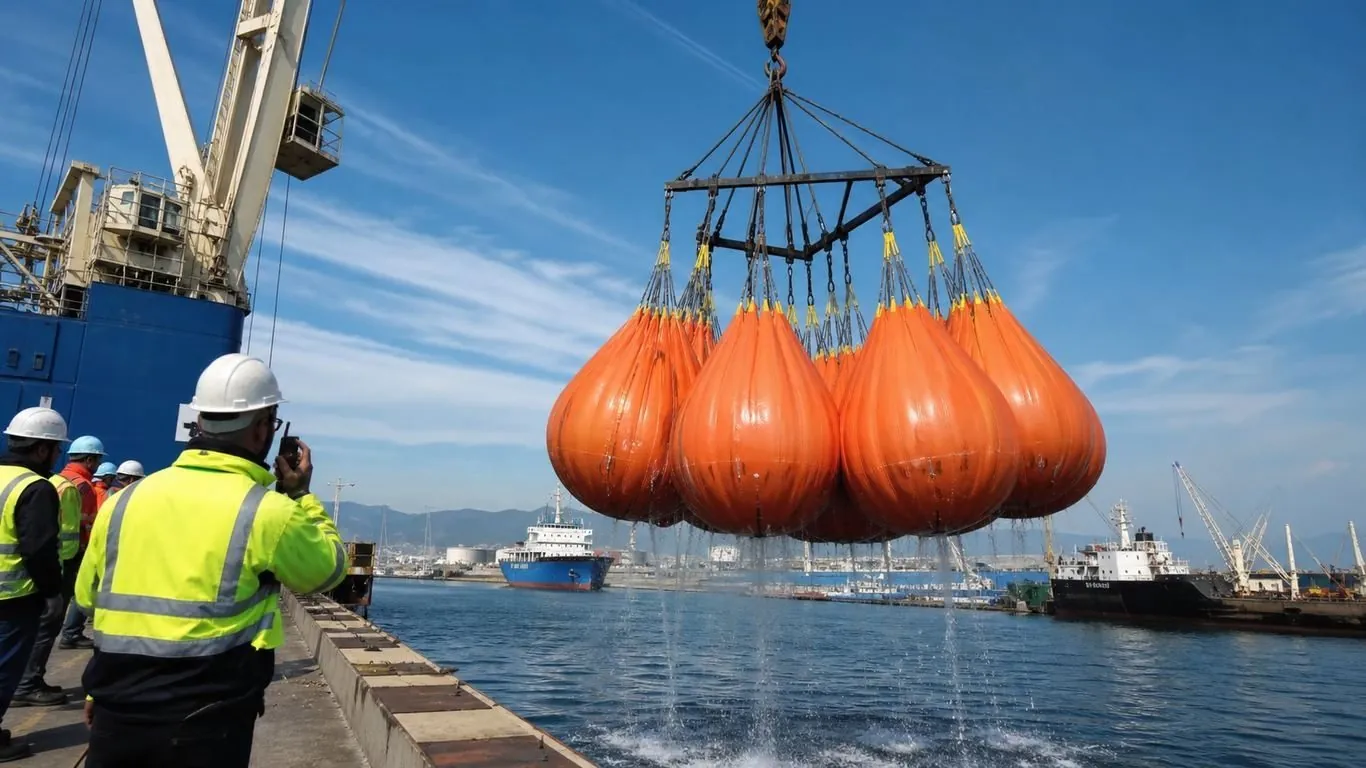
A proof load test applies a controlled overload — typically 125% of Safe Working Load (SWL) for cranes — to prove lifting equipment holds its rated capacity under static load without structural distress, and the certification documents it. In the UAE it's required after installation/mobilization, following major repairs or structural modification, at periodic thorough-examination cycles, and before critical man-riding use. Testing runs via calibrated water bags (ports/marine), certified test weights, or electronic load cells. Methods, standards, certificate anatomy and cost bands below.
Every SWL stamped on a crane or davit is a promise written by its manufacturer. A proof load test is where an independent inspection body makes that promise prove itself — with calibrated weight held against the structure while instruments watch. On UAE ports, rigs and project sites, that certificate is the document that lets lifts proceed. This 2026 guide covers what proof-load testing is, when it's mandatory, the three field methods, what's inside the certificate, and cost/logistics reality. After examinations pass, the colour that proves it rotates on the six-monthly cycle — our lifting equipment colour coding guide carries the 2026 rotation and the PDO-style campaign detail. The platforms that hang rather than lift follow a parallel discipline — rigging, ropes and launch checks — documented in our hanging scaffold guide. The operators who run those proof loads sit among the better-paid licensed roles — see the 2026 crane operator salary in Dubai for pay bands by crane type.
1. Proof Load vs Working Load — The Core Distinction
- SWL/WLL (Safe Working Load): the maximum the equipment may lift in service — its operating ceiling.
- Proof Load: the higher control-test load applied to verify integrity, classically 125% of SWL for crane-type appliances (varies by equipment class and governing standard — davit/derrick classes and accessories follow their own multipliers).
- The test proves structure, brakes and foundations hold the overload while stationary — it never licenses the equipment to lift that load in work.
2. When Is a Load Test Required in the UAE
| Trigger | Why | Typical Formality |
|---|---|---|
| After installation / mobilization to site | Transport & assembly can compromise integrity | Proof load + thorough examination before first service lift |
| After major repair/structural modification | Changed load paths must be re-proven | Proof test at specified percentage |
| Periodic thorough-examination cycles | Many TE schemes require test at intervals (esp. marine/offshore gear) | With the 6/12-month TE (TE guide) |
| Before man-riding/critical-personnel lifts | Human cargo multiplies assurance demands | Test + client-specific certification |
| Doubt/document-gap cases | Unknown history equipment | Case-by-case % set by the inspector/engineer |
3. The Three Field Methods (Who Uses What)
| Method | How It Works | Best For |
|---|---|---|
| Water bags | Calibrated flexible bags filled to calculated weight; load cell in rigging reads the lifted mass exactly | Ports/marine/offshore — cranes, derricks, davits (cheap heavy water, gentle application) |
| Certified test weights | Stacked certified steel/concrete blocks with traceable mass certificates | Site cranes/lifts where handling blocks is practical |
| Load cells/dynamometers | In-line electronic measurement between hook and known mass/anchor | Verification overlay in every method + equipment class testing |
Every mass applied must itself be certified traceable — the uncalibrated weight is the industry's favorite audit trap.
4. The Test Sequence (What's Actually Involved)
- Pre-test thorough examination: structure, wire ropes/sheaves, brakes, foundations reviewed first — testing damaged gear is sabotage, not verification.
- Load application in steps: partial percentages climbing to the proof value, pauses and readings at each plateau.
- Hold & observe: rated hold time at proof load with brake-slip measurements and structural observation.
- Post-test examination: re-check for deformation, cracking, play — the overload must leave zero footprint.
- Documentation: test certificate issued with readings, equipment data, examiner identity and next-due linkage.
5. What's Inside a Valid Load Test Certificate
- Equipment identity: serial/ID, model, location, owner.
- Rated SWL and the proof percentage applied (e.g., 125%) with the resulting test load in tonnes.
- Method & instrumentation: water bags/weights/calibrated load cells with calibration certificate references.
- Behavioral findings: brake slip (mm), deflection observations, hold-time results.
- Examiner & inspection body identity with scope/accreditation evidence (accreditation guide).
- Result (pass/fail), restrictions if any, and next-test linkage to the TE register.
6. Who Performs It (And Whose Certificate Gets Accepted)
On UAE commercial sites the accepted issuer is an ADNOC-approved/EIAC-ENAS-accredited third-party inspection body for client contexts requiring those approvals — self-testing by the equipment owner fails the independence premise (ADNOC TPI rules). Marine classes (vessels/offshore) sometimes additionally layer class-society requirements (ABS/DNV/BV context) — the client's scope statement names which acceptance layer governs.
7. Cost & Duration Reality (2026 UAE)
| Scenario | Typical Duration | Cost Band (AED) |
|---|---|---|
| Small davit/crane (≤10T) single test | Half-day | 1,500 – 4,000 |
| Site/mobile crane with water-bag setup | 1 day | 4,000 – 10,000 |
| Port/marine multi-stage (several radius points) | 1–2 days | 8,000 – 20,000+ |
| Combined TE + load-test packages | Per scope | Package pricing beats standalone (see TPI cost guide) |
8. Traps Around Load Testing
- Test-before-examination — stressing untested-for-defects machinery; TE always precedes the load.
- Uncalibrated weight claims — blocks/water without calibration references turn the certificate into paper.
- Percentage improvisation — "whatever we have onboard" loads don't meet the specified percent; the number must match the governing standard/class.
- Home-made certificates — owner-issued load tests fail third-party verification at client review (scope/pricing guide).
- Wind-blind scheduling — water-bag tests in crosswinds swing reads; schedule calm windows explicitly on the plan.
9. Where Load Testing Sits in the Bigger TPI Ecosystem
Proof-load certification is one instrument inside the full lifting-compliance set: 6-monthly accessory TE (see color-code linkage), 12-monthly appliance TE, NDT of structural members (NDT methods), and operator/training layers (operator courses). Operators who hold all of them in one report register pass audits in one sitting instead of assembling excuses. Between load tests, gear also carries its site colour tag — the current rotation and the free chart are in our ADNOC colour code chart 2026 guide.
10. How We Deliver Load Testing
As an ADNOC-approved inspection body we run proof-load programs end-to-end: calibrated water-bag fleets for marine/port work, certified weight sets for site cranes, in-line load cells verified against current calibration certificates, TE-first sequencing, and certificates formatted to client portal requirements. Send equipment list (types, SWL, location) — you receive the test plan, duration and per-item pricing the same day.
Equipment Due for Proof Testing?
Send equipment list + SWL + location — get the test plan, date and per-item price, same day.
💬 WhatsApp: Load Test QuoteLoad Test Certification UAE — the Quick Reference
Two queries dominate this page — "load test certification UAE" and "proof load test" — and both deserve the one-table answer before the depth this guide goes into. Load test certification in the UAE is the documented proof that lifting equipment has physically carried its proof load under controlled conditions, witnessed and certified by a competent third-party inspection body, and the certificate is what clients, ADNOC-circle contractors and municipality approvals actually ask to see. The test proves the equipment; the certificate proves the test. One without the other is a conversation, not a compliance document.
| What You Need | What Satisfies It | Watch Out For |
|---|---|---|
| The test itself | Proof load applied by water bag, certified weights or load cell, in stepped sequence | Uncalibrated masses — the audit trap this guide warns about |
| The certificate | Readings, equipment data, examiner identity, next-due linkage | Certificates with readings but no traceable examiner |
| The body issuing it | Recognised third-party inspection body (EIAC/ENAS-circle) | Self-certification offered as equivalent |
| The timing | Before first use, after modification or repair, and per the periodic schedule | Testing as an afterthought at mobilisation week |
The commercial pattern repeats across every UAE yard: the cheapest test is rarely the cheapest certificate, because a certificate a client won't accept is a retest with downtime attached. For the regime that wraps around load testing, see our lifting equipment inspection TPI guide, for the tag system that shows the result on the gear itself, the ADNOC colour code chart, and for the wider market, the third-party inspection UAE overview.
FAQs
- What is a proof load test? A controlled overload test — classically 125% of Safe Working Load for crane-type appliances — that proves lifting equipment can hold its rated capacity statically without structural distress. It verifies integrity; it does not raise the equipment's working limit.
- When is a load test required on lifting equipment in UAE? After installation/site mobilization, after major repair or structural modification, within periodic thorough-examination schemes (especially marine/offshore classes), before man-riding use, and wherever equipment history is unknown.
- How much does load testing cost in the UAE? Small single-unit tests (≤10T): AED 1,500–4,000; a site/mobile crane water-bag day: AED 4,000–10,000; port/marine multi-stage programs: AED 8,000–20,000+. Combined TE + test packages price better than standalone work.
- What is the difference between proof load and safe working load? SWL is the maximum the equipment may lift during normal service. The proof load is the higher test-only overload (typically 125% of SWL) applied under controlled conditions to prove structure and brakes tolerate it — never a working limit.
- Why are water bags used for load testing? Water offers cheap, precisely measurable heavy mass with gentle, non-shock application — ideal for large crane/davit tests at ports and offshore. Bag fill is calculated and lifted mass verified through calibrated load cells during the test.
- What should a valid load test certificate contain? Equipment identity, rated SWL and proof percentage with resulting test load, method and instrumentation with calibration references, brake-slip and hold results, examiner and inspection-body identity, pass/fail result, and linkage to the next thorough-examination due date.
- What is load test certification in the UAE? Documented proof — issued by a competent third-party inspection body — that lifting equipment has physically carried its calculated proof load in a controlled, stepped, witnessed test, with the readings, equipment data and examiner identity recorded on the certificate. Clients and regulators in the UAE ask for the certificate rather than the test itself, because it is the traceable artifact that survives audits, tender files and site access checks.
- How is a proof load test different from a working load test? A proof load test applies a load above the safe working load — typically in the 100–125% range of SWL depending on the equipment class and applicable standard — to verify structural integrity with margin, and it is performed at defined intervals, after repairs or modifications, and before first use. Working-load verification confirms function at rated capacity. The proof test stresses the structure; ordinary use never should, which is exactly why the certificate carries weight with approvers.

ADNOC-approved proof-load programs — calibrated water-bag fleets, certified weights, TE-first sequencing, portal-ready certificates. Official quotes: WhatsApp +971 52 382 9267 · See our accreditations →
Structural piles follow the same proof-test logic — the pile load testing guide for UAE projects covers kentledge and reaction systems.