 QUALITY INTL CERTIFICATIONS
H2S Breathing Apparatus & SCBA in the UAE: ADNOC Requirements
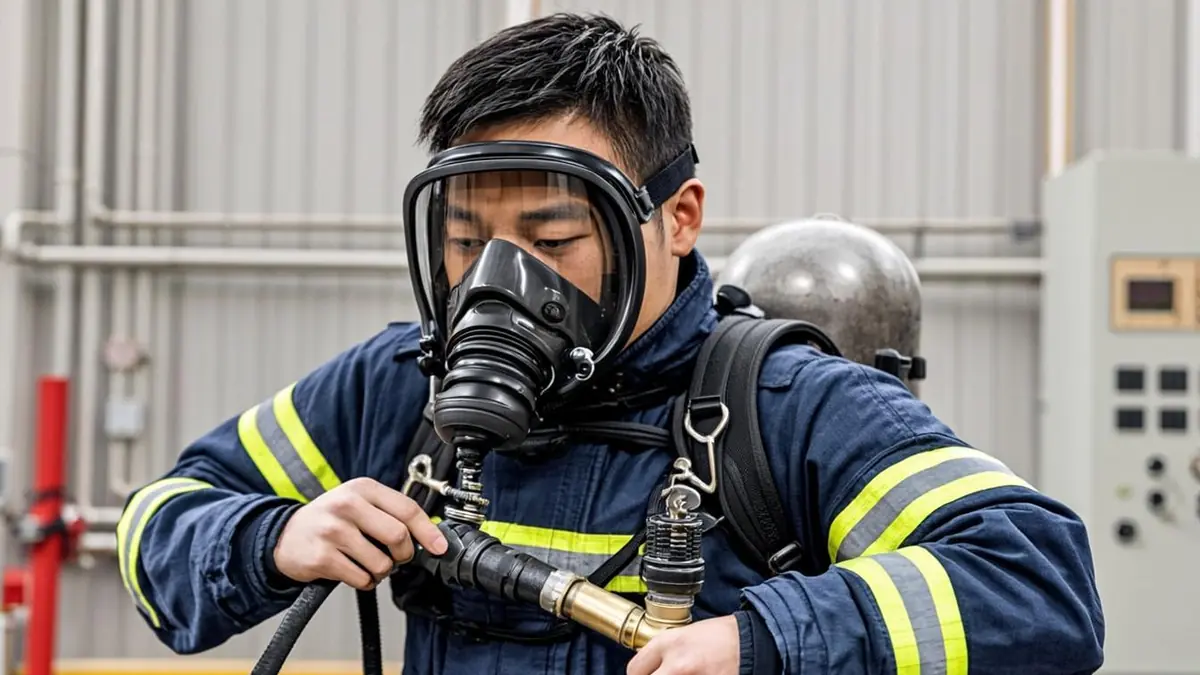
Hydrogen sulphide can create IDLH — immediately dangerous to life or health — atmospheres, where filter masks do not work and protection must be supplied air. Options: escape sets with 5–10 minute hoods, working SCBA with 30 or 60 minute cylinders, and airline systems with escape backup. Cylinders are conventionally full at 200+ bar; inspect monthly and fit test the mask.
Direct answer: H2S work in the UAE's energy sector runs on supplied-air protection, because hydrogen sulphide creates IDLH atmospheres where filter masks simply do not work. The three options are escape sets (5–10 minute hoods for evacuation only), working SCBA (30 or 60 minute cylinders for task work), and airline systems with an escape backup for extended-duration jobs. Cylinders are conventionally full at 200+ bar, masks are fit-tested against a clean-shaven seal, and ADNOC-family sites enforce site-specific rules on top of the equipment physics. The selection table below matches scenario to equipment — the decision most H2S queries are actually asking. Detector alarms and respirator change-outs key off the same numbers — the LEL UEL chart lays out the flammable-range bands.
Selecting, wearing and maintaining SCBA where H2S threatens UAE oil and gas workers.
Why H2S Demands Supplied Air, Not Filters
Hydrogen sulphide earns its reputation at Abu Dhabi's gas plants, offshore platforms and refineries: it is toxic, and it acts fast. Atmospheres with significant H2S are treated as IDLH — immediately dangerous to life or health — meaning exposure threatens survival or causes irreversible harm within moments, leaving no margin for filtration to save the day. Between the two H2S tiers both pay and exam difficulty step up — our H2S Level 1 vs Level 2 comparison sets out which ADNOC sites demand which level.
That single term, IDLH, decides the respirator question. Filter and cartridge masks work by cleaning the available air; when the atmosphere itself is the hazard, there is nothing safe to filter. For H2S, respiratory protection for entry work therefore means supplied air: self-contained breathing apparatus (SCBA) carrying its own supply, or airline systems feeding clean air from a distance. Anything less is not protection for the hazard — it is a false sense of security that fails exactly when needed. In Abu Dhabi's sour gas operations, offshore platforms and refinery units, supplied-air protection is the entry standard, not an option.
The Three Protection Options
Escape sets are the minimal answer: a hood that pulls over the head and a small air supply, rated conventionally for 5–10 minutes, with one job — move you from the release to breathable atmosphere. They are deliberately simple — pull over the head, activate, breathe — because panic does not read manuals. Working SCBA is the full answer: a back-mounted cylinder, full face mask and regulator, rated 30 or 60 minutes per convention, sized to the task and the walk out. Airline systems with escape backup combine a continuous feed through a hose with a small escape reserve, the combination of choice for longer tasks in H2S risk areas.
Selection is a planning exercise: distance to safe atmosphere, work rate, and the UAE summer's heat, which raises breathing rate and eats into duration margins. The cylinder rating is a planning figure, not a promise — a heavy, hurried, heat-stressed wearer consumes air far faster than the rating assumes.
| Type | Conventional Duration | Best For |
|---|---|---|
| Escape set (hood) | 5–10 minutes | Evacuating a release to safe air |
| Working SCBA | 30 or 60 minutes (rated) | Entry and work in H2S risk areas |
| Airline + escape combination | Continuous supply plus escape reserve | Long tasks with a planned exit |
Cylinder Pressure, Monthly Checks and Hydro Testing
Before every use, read the gauge. A full cylinder conventionally shows 200+ bar; anything less is a question to answer before entry, because duration estimates fall with pressure. During use, the low-pressure alarm means leave — now, not soon, because remaining air is measured in minutes the wearer does not control. Exit planning starts at the entry point, not at the alarm: know the route, the distance and the margin before the valve opens.
Monthly documented inspection covers the whole set: cylinder pressure and condition, straps and harness, valves and regulator function, mask integrity and air flow. Each check is recorded per set, so a gap in the log is visible before the audit rather than during it. Cylinders also follow a hydrostatic test cycle per practice — the test date is marked on the cylinder, and an out-of-test cylinder is out of service no matter how well it looks or reads. Operators running H2S areas in Abu Dhabi's oil and gas sector treat this paperwork as part of the plant, not an accessory to it, because auditors and incident investigators both start with it.
Mask Fit Testing and Donning Drills
A perfect apparatus with a leaking mask protects no one. Fit testing confirms the mask seals to the wearer's face — performed per the site programme before first use and periodically after, and rechecked whenever a new mask model arrives or anything changes the face's shape. Facial hair in the seal path is the classic failure, which is why clean-shaven rules follow H2S crews everywhere. A failed fit test is a training and assignment issue, not a reason to loosen the straps.
Donning drills are the other half of readiness. In a release, the alarm does not schedule itself around unfamiliarity with the equipment: crews rehearse putting the set on quickly, verifying it, and moving to muster until the sequence is muscle memory. Speed drills also expose the practical problems — tangled straps, a valve left closed, a harness mis-set — while they are still cheap to fix. Sites that skip periodic re-testing discover the gap the hard way: a mask that sealed last year may not seal after a model change, wear or repair.
Alarm Response, Buddy System and Rescue
When the H2S alarm sounds, the response is fixed: stop work, get the escape mask on if one is carried, evacuate upwind, and report to the muster point. Nobody freelances a release. The muster point sits upwind by design, and the head count tells the incident controller who is missing before anyone guesses. The buddy system pairs wearers so every person in an H2S area is watched by someone whose job includes noticing a collapse.
Rescue carries one absolute rule: never solo. The instinct to run in and drag a fallen colleague out is powerful, and it is how one fatality becomes three — the rescuer breathes the same atmosphere that dropped the first victim. Rescue is performed by a trained team in SCBA with a rehearsed plan, not improvised at the gate. Training requirements make this real: H2S training covers the hazard, the apparatus and the drills, and UAE sites verify competency before crews enter H2S service. Support from inspection providers such as QIC (Quality International Certifications), a UAE inspection and calibration company since 1998, helps keep equipment checks and records audit-ready.
Checklist
- Read the cylinder gauge before use — conventionally 200+ bar when full.
- Inspect sets monthly and record the check: pressure, straps, valves, mask, flow.
- Hydro-test cylinders on their cycle and retire out-of-test cylinders.
- Fit test masks before first use, after changes, and periodically.
- Keep faces clean-shaven in the mask seal path.
- Drill donning until the sequence is automatic.
- Pair every wearer under the buddy system.
- Fix the alarm response in every mind: stop, mask, upwind, muster.
- Never attempt rescue alone — trained team in SCBA only.
- Verify H2S training and competency before crews enter service.
Respiratory Protection Selection for H2S — SCBA vs Escape Set vs Airline
Selection is scenario-driven, not preference-driven: the job's duration, the atmosphere's certainty, and the escape distance decide the equipment. The consolidated selection table:
| Scenario | Equipment type | Minimum duration [VERIFY] | Training required | Inspection frequency |
|---|---|---|---|---|
| Evacuation from an H2S alarm | Escape set (hood type) | 5–10 minutes rated | H2S awareness + escape-set donning drill | Monthly visual + pre-use check |
| Short task work in possible H2S atmosphere | Working SCBA, 30-minute cylinder | 30 min rated (plan 2/3 work, 1/3 exit margin) | H2S training + SCBA wearer competency | Monthly + pre-use inspection |
| Extended task work, fixed location | Airline system + escape bailout set | Airline duration + 5–10 min escape backup | Airline + SCBA training | Per site regime + pre-use |
| Rescue of a downed worker | Working SCBA, 30 or 60-minute cylinder | 60 min preferred for rescue margin | Rescue-team training + SCBA | Monthly + pre-use |
| Confined space with H2S risk | SCBA or airline per entry permit + gas testing | Per permit calculation | Confined-space entry + SCBA | Pre-entry + continuous monitoring |
| Permanent fixed-site protection | Fixed air-line manifold / refuge | Continuous supply | Site-specific induction | Planned maintenance schedule |
The duration column carries the lesson most selection errors miss: a 30-minute cylinder is not 30 minutes of work. Competent programmes plan roughly two-thirds of rated duration for the task and hold one-third as exit margin — and rescue planning assumes the wearer is breathing fast, which consumes air faster than the rating's calm-breathing basis. The training column is not decorative either: an escape set worn by an untrained worker is a prop, which is why ADNOC-family inductions drill donning until it is muscle memory.
ADNOC Site Requirements — What Gate Checks and Permit Systems Enforce
ADNOC-family sites layer site rules on top of the equipment physics, and the pattern is consistent across the group's onshore and offshore assets. Fit testing is enforced with a clean-shave policy: facial hair that breaks the mask seal is a stop-work issue at gate checks, not a negotiation at the briefing. SCBA counts are maintained per the site's emergency-response plan — muster points, bottle banks and rescue teams sized to the occupancy. Permits for H2S-classified work name the respiratory protection explicitly: the permit's equipment line, the gas-testing regime around it, and the standby arrangements all travel together. And pre-use inspection is auditable: a bottle pulled at random must show its check record. The rules trace to the zone-classification logic our H2S zone classification guide maps — the zone decides who must carry what, where escape sets hang, and where working SCBA becomes the entry condition.
Pre-Use Inspection — the Sequence Before Every Shift
The pre-use check is a fixed sequence, and the discipline is doing it in the same order every time so omissions become visible. Cylinder pressure at gauge — full is conventionally 200+ bar, and anything below the site's floor stays racked. Cylinder and valve condition — dents, corrosion, damage to the valve handwheel. Harness and backplate — straps, buckles, the frame the cylinder rides on. Mask — lens, straps, exhalation valve, and the seal face that must sit against clean-shaven skin. Demand valve and warning whistle — the pressure-demand function and the low-air alarm that must sound at its setpoint. Then the donning and pressure-check: mask on, seal check per the trained method, breathe the system, confirm demand flow. Anything failing any step takes the set out of service with a tag — never a workaround. The full cylinder-care layer above (monthly inspections, hydrostatic testing cycles) catches what daily checks cannot; the daily check catches what months cannot. Between them sits the simple rule ADNOC-family sites enforce: every set, every wearer, every shift.
Frequently Asked Questions
What respirator is needed for H2S?
H2S atmospheres can be immediately dangerous to life or health (IDLH), so the required protection is supplied air: self-contained breathing apparatus for entry work, or an escape set for evacuation. Filter and cartridge masks do not protect in IDLH conditions and are not accepted for H2S entry work per standard practice.
How long does a SCBA cylinder last?
Working SCBA cylinders are rated at 30 or 60 minutes, but actual duration depends on the wearer's breathing rate — heavy work, stress and heat cut it well below the rating, a real factor in UAE summers. Plan the exit before entry with margin, and check the gauge reads full, conventionally 200+ bar, before use.
Can cartridge masks protect against H2S?
No. Cartridge masks filter the surrounding air, which only works when enough oxygen is present and concentrations stay low. H2S releases quickly create IDLH atmospheres where those conditions fail, so supplied-air SCBA or escape sets are the accepted protection per standard references — not filters.
How often is SCBA inspected?
Conventional practice is a monthly documented inspection covering cylinder pressure, straps, valves, mask condition and air flow, plus hydrostatic testing of cylinders on their test cycle. Before every use, check the gauge — conventionally full at 200+ bar — and confirm the apparatus flows correctly.
What do you do when the H2S alarm sounds?
Stop work, don the escape set if one is carried, and evacuate upwind of the release to the muster point. Never attempt a solo rescue — a person down in H2S needs a trained team in SCBA with backup. The alarm means leave first and let the emergency response investigate after.
What breathing apparatus is used for H2S?
Supplied-air protection, because H2S can create IDLH (immediately dangerous to life and health) atmospheres that filter masks cannot protect against. The three equipment families: escape sets with 5–10 minute hoods for evacuation, working SCBA with 30 or 60 minute cylinders for task work, and airline systems with an escape bailout set for extended-duration jobs at fixed locations. The scenario — not preference — decides which applies.
What is the difference between SCBA and an escape set?
Duration and purpose. An escape set is an evacuation device: a hood with 5–10 minutes of rated air, carried to walk out of an H2S atmosphere, never to work in one. Working SCBA is a task device: a full mask, demand valve, harness and 30 or 60 minute cylinder rated for work inside the atmosphere with exit margin. Escape sets hang at strategic points for everyone; SCBA is worn by trained, fit-tested personnel doing jobs the permit requires.
How long does an H2S escape set last?
Rated 5–10 minutes of air at calm breathing — and ratings assume composed breathing, which is why drills matter: a panicked user consumes air far faster than the rating's basis. Duration planning uses the escape distance: the set must carry the wearer from the work position to clean air or refuge. Anything longer than that distance demands either closer muster points or a different protection strategy, which is what the site's zone classification determines.
Is a beard allowed with SCBA on ADNOC sites?
No. ADNOC-family sites enforce a clean-shave policy wherever a respirator seal is required, because facial hair breaking the mask-to-skin seal defeats the protection the set provides — fit testing quantifies the seal, and a beard makes the fit test unpassable. Gate checks and permit briefings treat it as a stop-work condition. Workers with genuine medical or religious exemptions are assigned roles that do not require respirator seals, not exceptions to the physics.
How often must SCBA be inspected?
Three layers: a pre-use inspection before every shift by the wearer (pressure, cylinder, harness, mask, demand valve, alarm); a monthly formal inspection with records per set; and periodic hydrostatic testing of cylinders on their certification cycle. ADNOC-family sites audit all three — a randomly pulled bottle must show its check record. The pre-use catch catches what months cannot; the monthly and hydro layers catch what daily checks cannot.