AGT Course Abu Dhabi: ADNOC Onshore vs OPITO 9240 — Which Gas Tester Card? (2026)
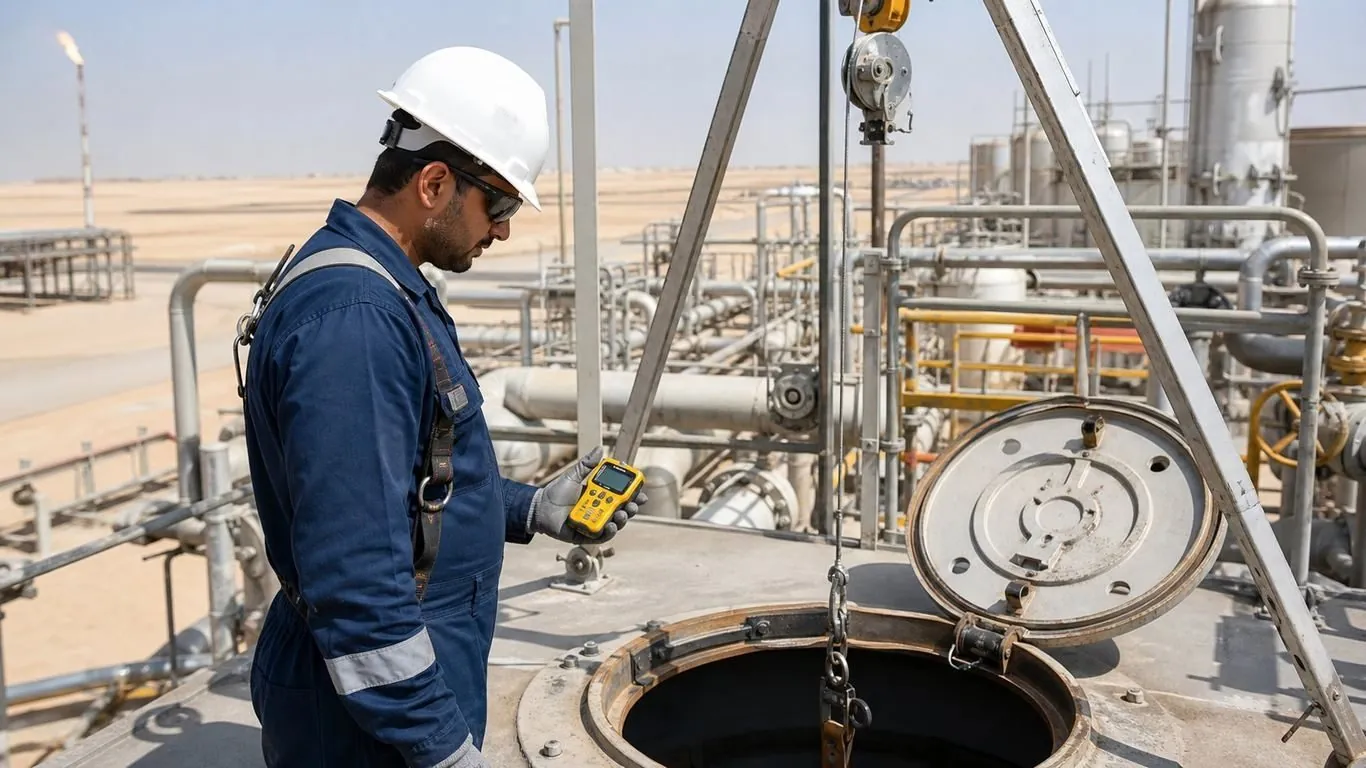
Is the AGT certificate mandatory for ADNOC sites? — For anyone performing atmospheric testing as part of a permit — yes. ADNOC Onshore requires Authorized Gas Testers under its Permit-to-Work system, and ADNOC Offshore expects the OPITO 9240 AGT certificate. No valid AGT card means no gas tests, and no gas tests means the permit stops. The hardware itself is mapped in our multi gas detector guide — sensors, alarms and UAE prices.
On an ADNOC site, nothing hot and nothing confined starts until one person with a detector says the air is safe — the Authorized Gas Tester (AGT). It's a small card with a huge signature: your readings literally open the permit. But the UAE has two different AGT cards, and booking the wrong one wastes a day and a fee. This guide separates them properly: who needs what, what's inside the course, the zone rules, and how it fits with your H2S ticket. The O2 acceptance band and test sequence are detailed in our confined space oxygen level guide. Zone boundaries are what gas tests confirm — the Green/Yellow/Amber/Red definitions sit in our H2S zone classification guide. The limits behind every reading — LEL and UEL per gas, and what permits demand — are charted in our LEL UEL chart guide. The H2S assessment itself — format, passing score and retake discipline — has its own preparation guide in our ADNOC H2S exam guide. Testers who certify atmospheres usually specify the respiratory protection as well — the SCBA for H2S guide covers selection and duration rules. Receiver and gas-tester roles often sit with the same crew — the ADNOC WPR training guide explains the permit receiver side of that pairing.
Who Must Hold an AGT Card?
- Standby persons / safety watches — guarding confined space entries and hot work
- HSE officers & supervisors — authorizing or verifying permit conditions
- Operations & maintenance crews — anyone working around process equipment, vessels or lines
- Technicians heading to ADNOC Onshore or Offshore scopes — the permit system names the AGT explicitly
If your job description includes "conduct gas testing as per ADNOC Onshore Permit to Work" — that is literally the card's definition.
The Two Cards, Side by Side
| Factor | ADNOC Onshore AGT | OPITO AGT (9240) |
|---|---|---|
| Built for | ADNOC onshore facilities (Bab, Habshan, Asab…) | Offshore platforms & international oil & gas |
| Framework | ADNOC Onshore Permit-to-Work alignment | OPITO global standard, code 9240 |
| Monitors practiced on | ADNOC Onshore portable monitor types | Aspirated & non-aspirated industrial detectors |
| Core modules | Hazardous atmospheres · gas-test practices in PTW · monitoring practicals | OIS-102 tester skills · OIS-103 hot work flammables · OIS-104 confined space · OIS-105 continuous monitoring |
| Duration | 1 day | 1 day |
| Validity | 3 years (refresher before expiry) | 3 years (refresher before expiry) |
Rule of thumb: going onshore → ADNOC-aligned card. Going offshore or to non-ADNOC international projects → OPITO 9240. Technicians who mobilize across both often carry both cards — the content overlaps but the checkboxes don't.
Inside the Course (What You'll Actually Learn)
- Hazardous atmospheres — flammable/explosive ranges (LEL/UEL), oxygen enrichment & deficiency, toxic contaminants like H2S and CO
- Gas-test practice under PTW — when tests are required, frequency, terminology, gas dispersion and why heavier-than-air gases pool at the bottom of vessels
- Monitoring in practice — detector self-test, function checks, calibration vs bump-test, sampling technique (the O-H-T order: Oxygen → Flammable → Toxic), interpreting normal vs abnormal readings, vertical-vessel representative sampling
- Documentation & response — recording results for the permit, suspending work on abnormal readings, escalation paths
ADNOC Risk Zones You Must Know
Abu Dhabi classifications tie your equipment to the area's H2S risk:
- 🔴 Red Zone — high risk of lethal H2S release → SCBA mandatory
- 🟠 Amber Zone — tolerable risk → EEBA (escape breathing apparatus/mask) required
- 🟡🟢 Yellow/Green Zones — lower risk → monitoring still mandatory
AGTs aren't just allowed in these zones — they are the people who keep them measurable for everyone else. (Zone PPE rules slot next to your H2S Level 1/2 requirements.)
AGT + H2S + Confined Space: The Card Set Gates Actually Check
Mobilization document checks rarely stop at one card. The pattern for process-area roles stacks up as: Onshore HSE Induction → H2S (level per role) → AGT → Confined Space (CSA/CSE where entry applies). Book them in that order and your file reads exactly the way the reviewer expects. Our confined space guide covers the CSA/CSE side.
AGT Course in Dubai and Abu Dhabi — Expiry, Fees and the Renewal Window
A steady stream of searches reaching this page type "authorized gas tester training in Dubai", "AGT ADNOC" and "AGT Abu Dhabi" — with the follow-up question "gas test atmospheres expiry" arriving almost as often. The location answer first: the ADNOC-aligned AGT course trains to the onshore permit system wherever it is delivered, so a course run in Dubai still produces the ADNOC-circle card that Abu Dhabi gate controls read — what matters is the authorization behind the provider, not the emirate of the classroom. The expiry answer second, because it is the one that stops work: both the ADNOC-aligned course and the OPITO 9240 card run three years, and an expired card stops permits at the gate until re-certification clears.
| Card | Where Mandated | Validity | Renewal Reality |
|---|---|---|---|
| ADNOC-aligned AGT | ADNOC Onshore scopes; any PTW requiring atmospheric testing | 3 years | Re-certify before expiry — lapsed cards halt permits |
| OPITO 9240 (gas test atmospheres) | ADNOC Offshore; international offshore scopes | 3 years | Same gate rule offshore; booking windows tighten in campaign season |
On fees, the honest bracket is the one-day ADNOC card course ladder our PTW card fees guide maps: awareness and holder-level cards sit in the lower one-day band, with exact AGT pricing set by provider, format and cohort size — book through the training coordinator for group rates rather than seat-by-seat. The card set logic matters more than any single fee: gas testing authorizes the permit, but the scopes that hire AGTs usually stack H2S and confined-space alongside it — the combination our H2S training guide and confined space training guide document. Renewal scheduling is the quiet discipline: book the refresher inside the final six months of validity, because campaign-season slots in Abu Dhabi fill exactly when expiries cluster.
Quick FAQ
Is the AGT certificate mandatory for ADNOC sites? For anyone performing atmospheric testing under a permit — yes. Onshore requires ADNOC-authorized gas testers under its Permit-to-Work system; Offshore expects OPITO 9240. No valid AGT, no gas tests, no permit.
ADNOC Onshore AGT vs OPITO 9240 — which do I need? Onshore ADNOC facilities → ADNOC-aligned card taught on ADNOC monitor types. Offshore and international projects → OPITO 9240 (OIS-102–105 modules). Cross-mobilization technicians often hold both.
How long is it valid? Three years both pathways. A refresher with re-assessment must be completed before expiry; lapsed cards stop permits until renewed.
How long is the course? One intensive day: theory, detector self-tests and bump checks, O-H-T sampling sequence, confined-space and hot-work scenarios, plus permit documentation practice on ADNOC-type monitors.
Do I need H2S first? Strongly recommended and commonly required by mobilization — AGT assumes you know toxic-gas basics, and most ADNOC scopes ask for H2S anyway.
What does an AGT actually do? Tests oxygen, flammables and toxic gases in the correct sequence at correct points and intervals, then signs those readings into the permit. Their accuracy literally authorizes entry and hot work.
How long is the AGT certificate valid for? Three years, for both the ADNOC-aligned authorized gas tester course and the OPITO 9240 gas test atmospheres card. The validity clock is read at the gate, not negotiated — an expired AGT means no gas tests, and no gas tests means the permit stops until re-certification. Book the refresher inside the final six months of validity so campaign-season demand does not turn a routine renewal into a work stoppage.
Can I take ADNOC AGT training in Dubai for an Abu Dhabi scope? Yes — the ADNOC-aligned AGT course certifies to the onshore permit system regardless of where the classroom sits, so a Dubai-delivered course produces the same ADNOC-circle card that Abu Dhabi gate controls read. What to verify instead of the emirate is the provider's authorization and the card's registration path. Fees follow the one-day ADNOC card course ladder: provider-quoted, with employer cohorts priced as a mobilisation wave rather than open-schedule seats.
Mobilizing to an ADNOC Scope?
Tell us onshore or offshore, and how many seats — we'll confirm the exact AGT pathway and the next batch in Abu Dhabi.
💬 WhatsApp: Next AGT BatchNeed the Full Card Set?
Induction → H2S → AGT → Confined Space in one plan: WhatsApp your project name and crew size — a coordinator maps the batch calendar for you.
💬 WhatsApp +971 52 382 9267
Certification partner in the UAE since 1998 · EIAC (IB-125) & ENAS accredited · KHDA permits · ADNOC-approved course delivery for WMS, H2S, HSE-Induction, WMS & more. Official quotes: WhatsApp +971 52 382 9267 · See our accreditations →
Gas testers and rescue crew train side by side on most sites — compare confined space rescue training options in UAE alongside your AGT certification.
AGTs typically act as permit firewatch signatories — the ADNOC permit-to-work responsibilities guide clarifies the crossover duties.