Confined Space Rescue Training UAE 2026: Team Roles, Equipment & Drill Standards
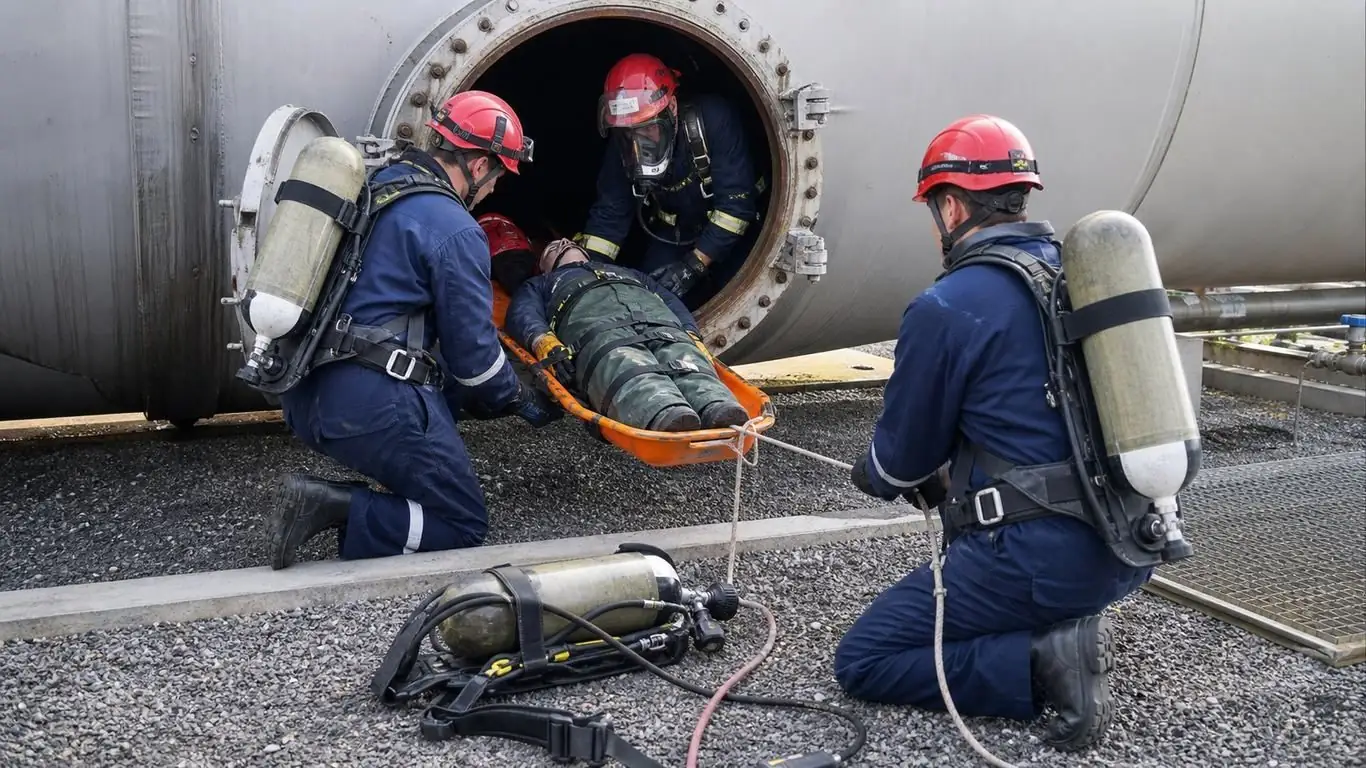
Confined space rescue training certifies a dedicated rescue capability that must exist BEFORE any entry begins: a non-entry method first (retrieval winch/tripod pulling the entrant out), with entry-rescue as the trained escalation. UAE 2026 format: 1–2 days covering rescue-team roles, tripod/winch systems, SCBA/SAR breathing apparatus, casualty packaging, and live drills; fees typically AED 800–1,800 per person. The permit attendant is NOT the rescue team — that confusion is where UAE site plans fail audits. Full breakdown below.
Every confined-space permit names a rescue plan; on most UAE sites that "plan" is a tripod photo and a hope. When a 60-kg worker collapses four metres down a tank — oxygen gone, alarm screaming — hope does not lift anyone. This guide covers the rescue layer that training actually must build: team roles, non-entry-first equipment, breathing apparatus decisions, drill discipline, and the 2026 course market. The atmospheric-hazard sibling of this rescue training — H2S levels, zone classification and the SCBA layer for ADNOC-family sites — is covered in our H2S training Abu Dhabi guide. Rope technicians supply many of the region’s rescue teams — the rope access course fees UAE page details the IRATA levels behind that capability. Rescue competence formally includes casualty care — the first aid CPR AED course UAE page prices the medical module. For the full picture on this, our Confined Space Rescue Course UAE covers confined space rescue course fees in the uae 2026.
1. Why 'Call 997' Is Not a Rescue Plan
Atmospheric incapacitation runs on a 4-minute brain clock; municipal response times simply don't fit. ADNOC-standard and audited UAE sites therefore demand an on-site immediate rescue capability for every live entry — equipment rigged and trained people standing by, before the attendant opens the log. Civil Defence is the escalation, never the plan.
2. Rescue Team Roles (Minimum Live-Entry Setup)
| Role | Duty During Entry |
|---|---|
| Permit attendant / standby | Watches, logs, communicates — NEVER enters; initiates rescue by alarm and retrieval, not heroism (see our attendant duties in the 12-step guide) |
| Rescue team (2+ minimum) | Operates retrieval system immediately; entry-rescue only if trained/equipped and directed |
| Rescue supervisor | Owns the rescue plan, drill schedule, equipment readiness logs |
| Gas tester support | Continuous atmospheric data for the rescue decision (AGT skill-set) |
3. Non-Entry First (The Hierarchy Sites Must Prove)
- Retrieval system: full-body harness with dorsal/shoulder attachment + tripod or davit + mechanical winch (4:1 typical) — casualty lifted without anyone entering. This is the default plan for vertical entries.
- Entry rescue: only where geometry defeats retrieval (horizontals, internal obstructions) — requires entry-trained rescuers with breathing apparatus, communications and their OWN backup provision.
- If the risk assessment can't guarantee non-entry rescue, the entry method itself changes (re-engineer access) — not the rescue plan's optimism.
4. Equipment the Course Trains Hands-On
- Tripod / davit arm systems: setup, rated anchorage, edge management.
- Mechanical winches & SRLs (self-retracting lifelines with retrieval function).
- SCBA (self-contained breathing apparatus) vs SAR (supplied-air respirator with escape cylinder) — selection logic, donning drills, cylinder management.
- Casualty packaging: rescue harnesses, SKED/stretchers for horizontal extraction.
- Communications, atmospheric monitoring continuity during rescue.
5. UAE Course Format & 2026 Fees
| Element | Typical UAE Standard |
|---|---|
| Duration | 1–2 days (practical-heavy; scenario drills mandatory) |
| Fees | AED 800 – 1,800 per person (equipment-intensive course) |
| Prerequisites | Confined space entry training + medical fitness (BA work is cardio-real) |
| Assessment | Timed live drill (rigging + simulated extraction) + written knowledge paper |
| Validity | Commonly 2 years; refresher drills expected in between |
6. What Live Drills Actually Test
- Alarm-to-lift time: casualty retrieval initiated within ~2–3 minutes of collapse call.
- Cold-setup to ready-rigged: tripod assembled/moved between work fronts under time pressure.
- BA donning under stress (for entry-capable teams).
- Casualty packaging on a limp-weight dummy (real limp bodies are three times harder — trainees learn this day one).
- Communication breakdowns: what the team does when the radio dies mid-extraction.
7. Drill Frequency & Records (What Auditors Ask For)
- Documented rescue drills per entry-type at least per permit-cycle on long projects (quarterly common; ADNOC-standard scopes may demand more).
- Equipment readiness logs: winch function tests, BA cylinder pressures, harness inspection tags.
- Named rescue coverage per shift — a rescue plan whose trained members are off-site is void on its face.
8. Common UAE Site Failures
- Tripod present, winch seized — equipment bought, never function-tested; fatal at the one moment it matters.
- Attendant entering — the original multiple-fatality pattern (over half of confined-space deaths are rescuers).
- Rescue gear locked in the store — equipment 200 metres from the live entry is equipment that doesn't exist.
- Horizontal spaces pretending to be vertical — tripods don't rescue around corners; the plan was fiction from the start.
- No drill ever run — teams discover gear incompatibility during a body recovery instead of a training morning.
9. Who Needs This vs Basic Entry Training
Every entrant and attendant takes entry training; the rescue layer adds to: designated rescue-team members (explicit in the permit), supervisors of confined-space work, emergency-response members at plants with routine entries, and HSE officers responsible for writing rescue plans that survive audits. H2S-rich plants stack this with H2S training since sour-gas rescues carry BA complexity by default.
10. Where We Fit
Our confined-space vertical runs the full ladder: entry + attendant programs, rescue-team certification with live-extraction drills at your space types (bring the drawing; we drill YOUR geometry), drill-day refreshers with readiness audits, and rescue-plan documentation that stands in front of client and Civil Defence review. WhatsApp your space list and entry frequency — we'll size the rescue capability honestly.
Live Entries Without a Real Rescue Plan?
Send your space types + team size — get rescue-training dates, drill-day options, and an equipment-readiness audit scope.
WhatsApp: Rescue TrainingFAQs
- Is confined space rescue training mandatory in the UAE? A written rescue plan is mandatory for every confined-space entry under client/ADNOC standards and Civil Defence expectations; trained rescue capability on-site is what makes that plan legally alive — 'call 997' alone does not satisfy audits.
- How much is confined space rescue training in the UAE? Typically AED 800–1,800 per person for 1–2 practical-heavy days covering retrieval systems, breathing apparatus, casualty packaging and timed live-extraction drills.
- Can the confined space attendant perform the rescue? The attendant raises the alarm and operates non-entry retrieval (winch/tripod), but must NEVER enter — over half of confined-space fatalities are would-be rescuers, which is exactly why entry rescue requires separately trained and equipped team members.
- What equipment is used for confined space rescue? Tripod/davit with mechanical winch and SRLs for non-entry retrieval; SCBA or supplied-air respirators for entry rescue; rescue harnesses and SKED stretchers for casualty packaging; plus continuous gas monitoring and communications.
- How often should confined space rescue drills be done? Documented drills at least quarterly on long projects is common practice, with ADNOC-standard scopes demanding more frequent coverage; drills must cover your actual space geometries and be logged with equipment readiness checks.
- What is the difference between SCBA and SAR in confined space rescue? SCBA is a self-contained cylinder set giving full independence for entry rescue; SAR is supplied-air fed by a hose line from outside with a small escape cylinder — longer duration but the line constrains movement in complex spaces.

Confined-space practitioners: entry & rescue certification, live-extraction drills on your geometry, and audit-proof rescue plans. Official quotes: WhatsApp +971 52 382 9267 · See our accreditations →